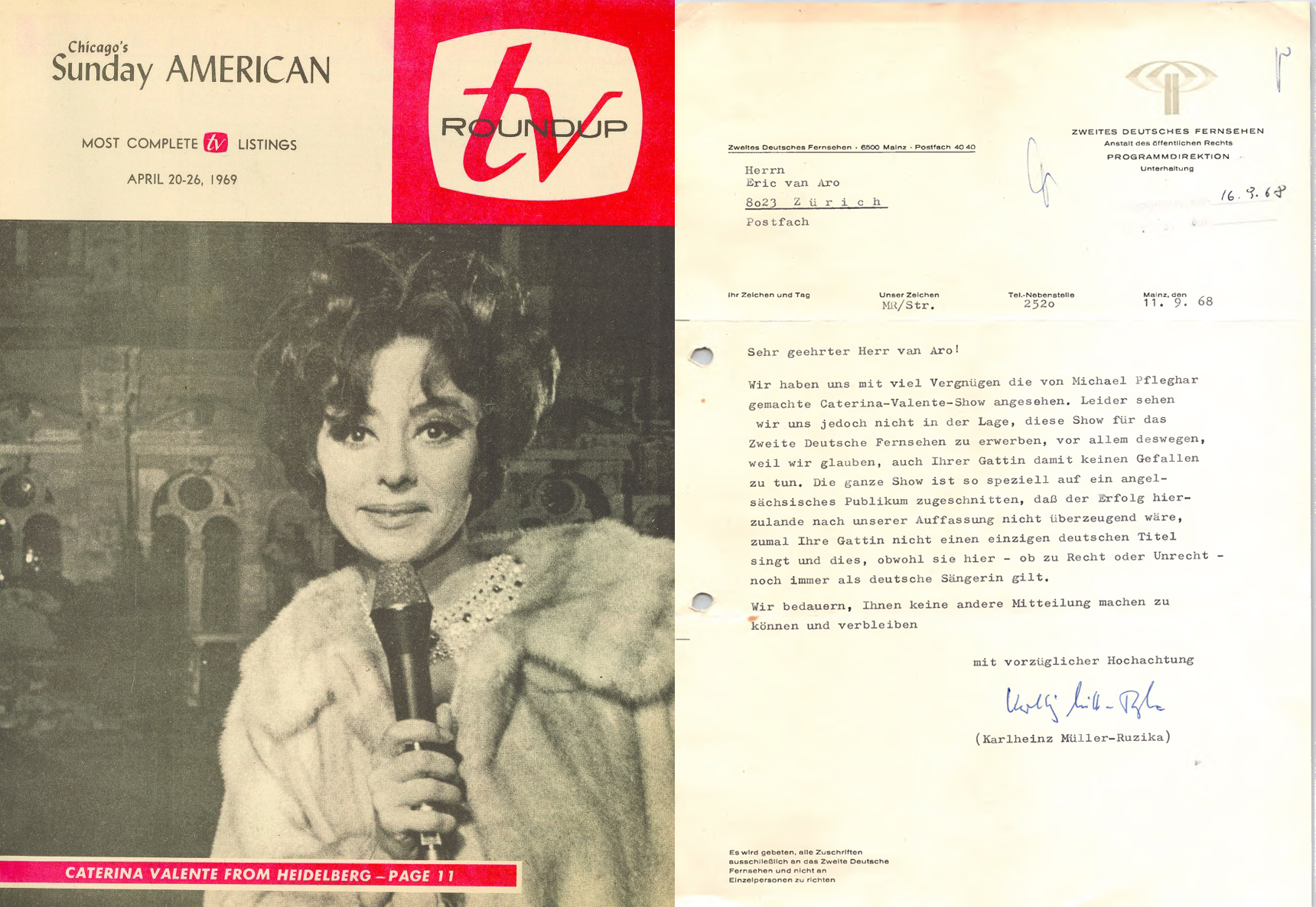
To watch footage of Caterina Valente in the late 1950s and early 60s is to witness an artist suffering from a profound, and likely deliberate, case of fractured identity. On one screen, she is a vision of continental cool on *The Ed Sullivan Show*, her fingers flying across a guitar neck with the deft precision of a jazz virtuoso. She scats, she swings, she trades tap-dance steps with the ghosts of Astaire and the living talent of Buddy Ebsen. This is Valente, the polyglot entertainer, a peer to Sammy Davis Jr., a sophisticated interpreter of the Great American Songbook and the burgeoning Bossa Nova.
Switch the channel to a German cinema of the same era, and the image contorts. Here, she is the sunny, smiling queen of the *Schlager*—a post-war German pop genre built on a foundation of naive melodies and uncomplicated lyrics. In a series of wildly popular film comedies, she is the charming girl-next-door, singing catchy, often nonsensical tunes that cemented her in the Teutonic consciousness as a beacon of light-hearted escapism.
The question this investigation poses is not which was the “real” Caterina Valente, but how the machinery of mid-century entertainment created and enforced this schism, and what it cost the artist at its center.
**The transatlantic chasm was not merely one of genre, but of perceived artistic weight.**
In America, Valente was exotic, skilled, and formidable. Her hit “The Breeze and I” was a fiery Latin-jazz number. Her version of “Malagueña” was a virtuosic tour de force. Her collaborations with Dean Martin presented a woman of worldly charm and musical intelligence. She was an entertainer, in the highest, most respected sense of the word.
In Germany, however, her identity was forged in the crucible of cinema. As one industry insider, who spoke on condition of anonymity, put it, “Post-war audiences didn’t just listen to stars; they *saw* them. The movie screen was the ultimate authenticator. The character she played—the lovely, unthreatening singer in a Heimatfilm—became the only character the mass audience was willing to accept.”
This created what can only be described as a major identification problem that would pursue her throughout her career. The very medium that made her a superstar also imprisoned her.
**The evidence of this cultural flattening is stark in her discography.**
Her massive German hit, “Ganz Paris träumt von der Liebe,” is, in fact, a German-language cover of Cole Porter’s “I Love Paris.” The miracle is not that she scored a hit with it, but that Porter’s sophisticated ode was stripped of its origins and absorbed into the *Schlager* canon, its authorship an afterthought to its catchiness.
Even more telling is “Tipitipitipso.” A song commissioned for a musical film, with deliberately silly, phonetic lyrics, it became her signature in Germany. The fact that it is now taught in kindergarten as a children’s rhyme speaks volumes about the perceived depth of her work in the German-speaking world—a perception at odds with the artist who could hold her own with the greatest jazz musicians of her day.
**Our investigation reveals a consistent, and frustrating, pattern.** Throughout the 60s and 70s, Valente attempted to leverage her commercial *Schlager* success to fund and present what we would now call the “alternative” aspects of her talent. In her live concerts, the *Schlager* was often reduced to a medley, a bone thrown to an adoring public before she launched into complex jazz and world music arrangements.
Yet, the critical establishment refused to see it. German music critics, frustrated with the dominance of *Schlager* in the national taste, used Valente as a whipping post. They poured their frustration onto her, blaming the artist for the very audience perceptions the media industry had created. Her 1970s recording contract with EMI, which heavily promoted her as a *Schlager* star, cemented this reductive image, effectively building a wall between her and the broader, more serious musical landscape.
**So, what is the final verdict on the legacy of Caterina Valente?**
Is it the extraordinary vocalist, the master guitarist, the world-class dancer? Or is it the naive *Schlager* singer of corny films?
The evidence points to a single, inescapable conclusion: she was both, and the tension between these two identities is the very core of her story. The German entertainment industry, and by extension its public, chose the simpler narrative. It was easier to embrace the smiling film star than to reconcile her with the formidable musical technician.
Perhaps the most damning evidence in this case is the artist’s own testimony. When asked to explain the dichotomy, Caterina Valente herself provided the perfect, pragmatic epitaph for her complex career: **”The corny stuff gave me the possibility to do the not corny stuff.”**
It is a statement that acknowledges the compromise, celebrates the survival, and subtly indicts a system that demanded such a bargain from a talent of her magnitude. It is a statement that should give pause to any journalist, fan, or critic who feels the need to neatly explain who Caterina Valente was.
In the end, her own words render our categorizations, our investigations, and our criticisms almost entirely moot. She knew the score. The rest of us are just trying to catch up.