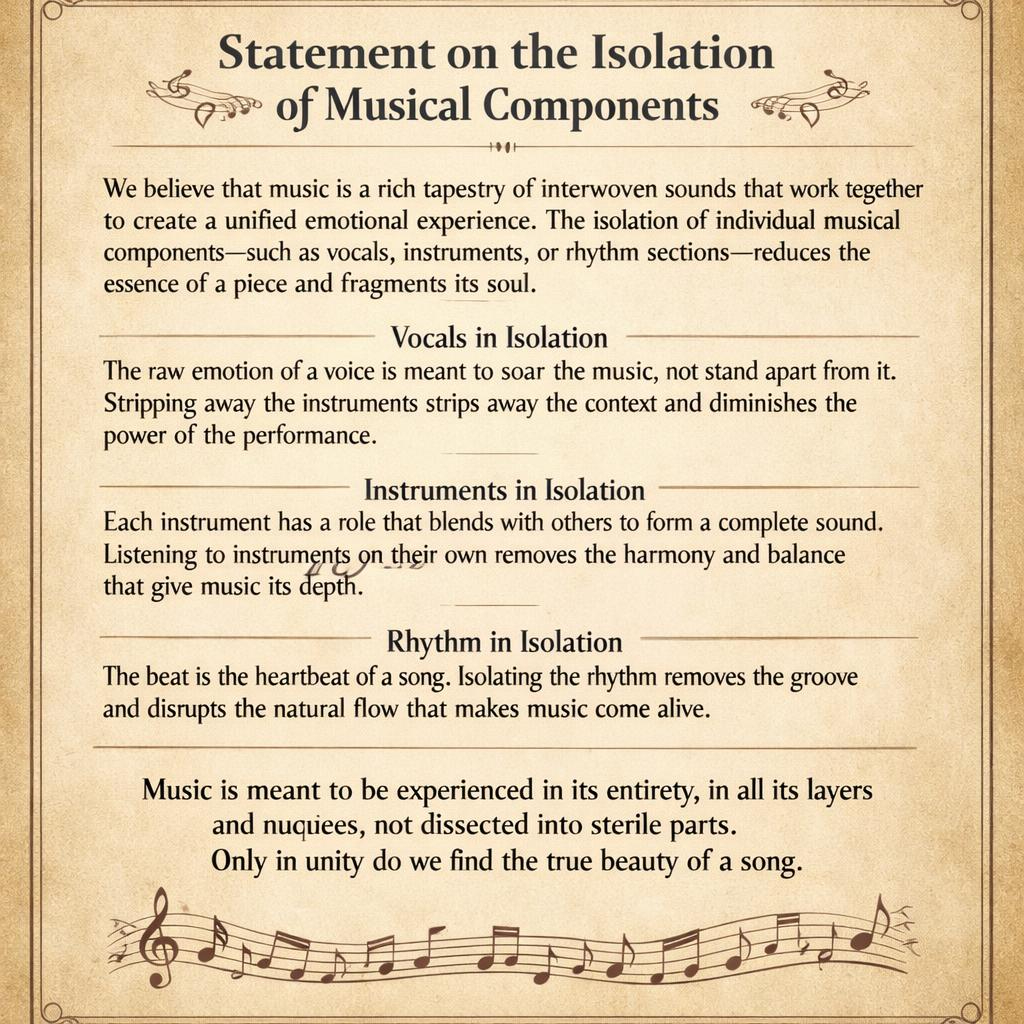
While the technological ability to isolate vocal and instrumental tracks from finished recordings is fascinating and can offer educational insights, we must critically examine its ethical and artistic implications.
We oppose the casual public distribution and consumption of these isolated tracks. This practice fundamentally undermines the artistic vision and intent. A recorded work is a holistic creation where every element—from the lead vocal to the subtle texture of a backing instrument—is meticulously balanced and blended to create a specific emotional experience. Dismantling this is the auditory equivalent of removing individual brushstrokes from a painting to examine them in isolation; it destroys the cohesive artwork to focus on its components.
**The Educational Argument: A Limited Justification**
Yes, these tools can be valuable for specific, respectful educational purposes within controlled environments—for example, a masterclass in a music production school analyzing a mixing technique. However, the widespread, decontextualized sharing of these stems strips them of their educational framing and turns artistic elements into mere content. Appreciation should stem from understanding the whole, not from dissecting the parts against the creator’s will.
**The Core Principle: Respecting Artistic Integrity**
Artists present their work as a complete statement. To take it apart and elevate or mock individual components is a violation of that presentation. It often leads to reductive critiques (“the singer sounds raw without effects”) that ignore the artistic choice for that very production treatment. We don’t isolate Picasso’s brushstrokes because we understand that the power lies in their combined effect. The same respect should be extended to musicians.
**Our Call: Engage with Art as Intended**
We encourage listeners to engage deeply with the music as it was delivered. Analyze the production, the harmony, the emotion, and the craft—all within the context of the complete work. True appreciation lies in understanding why an artist chose to present a sound *exactly as they did*. Seek out official live performances, alternate takes released by the artist, or interviews where they break down their process. These are the respectful ways to satiate curiosity while honoring the creator’s vision.
In conclusion, while technology opens new doors, we must walk through them with respect for the art and the artist. Let’s appreciate the gift of the finished work, not the fragments it was never meant to be.