**TO:** The Audience
**FROM:** The Observers
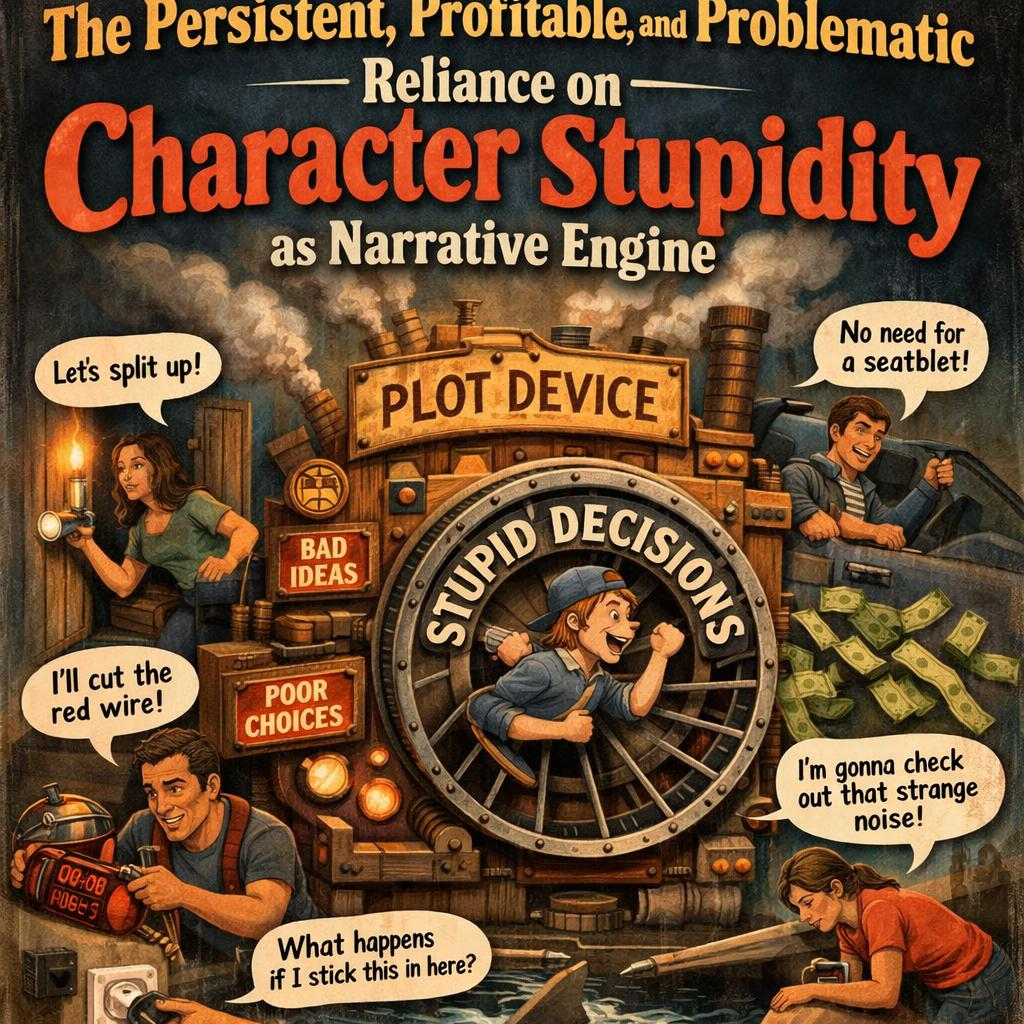
**SUBJECT:** The Persistent, Profitable, and Problematic Reliance on Character Stupidity as Narrative Engine
**1.0 EXECUTIVE SUMMARY**
For over half a century, a silent pandemic has infected our stories. It is not a virus of style or genre, but of **cognitive decay**. Our investigation concludes that a significant portion of mainstream film and television narrative conflict is generated not by sophisticated antagonists, moral quandaries, or unforgiving circumstances, but by the **calculated, artificial stupidity of protagonists**. This device is disproportionately applied to young characters, using “youth” as a veneer to mask a deeper, more systemic writing failure. The central question stands: Is this a necessary story mechanic, or the symptom of a creative industry in crisis?
**2.0 THE EVIDENCE: A PATTERN OF ABSURDITY**
Our forensic analysis of viewing patterns reveals a clear and recurring modus operandi:
* **The Horror Vector (Code: “Don’t Go In There!”):** Characters hear a disturbance in a location established as lethally dangerous. Rational response: Barricade, arm, call for help, flee. *Stupidity-Driven Response:* Proceed alone, unarmed, while calling out softly. Result: Plot advances via death or discovery.
* **The Teen Drama Vector (Code: “The Worst Possible Confidant”):** A character possesses a life-altering secret. Rational response: Keep it, or tell one trusted, discrete ally. *Stupidity-Driven Response:* Immediately divulge to the school’s most notorious gossip during a crowded social event. Result: Plot advances via social chaos.
* **The Action/Thriller Vector (Code: “The Premature Trust”):** After a tense alliance, a known betrayer shows a flicker of decency. Rational response: Maintain vigilant, conditional cooperation. *Stupidity-Driven Response:* Holster weapon, turn back, and say, “I knew you were good deep down.” Result: Plot advances via (predictable) betrayal.
This is not human error. This is **narrative malware**.
**3.0 THE YOUTH JUSTIFICATION: A FLAWED ALIBI**
The primary cover story for this character incompetence is **”inexperience.”** Our investigation finds this alibi insufficient and, in fact, damaging.
* **Inexperience vs. Cognitive Disability:** A young person misjudging a social cue or being overly optimistic is human. A young person, who has successfully navigated to a remote cabin, suddenly being unable to comprehend the concept of “locking a door” or “staying together” is a narrative contrivance.
* **The Patronization Effect:** This trope perpetuates the cultural notion that young people are inherently incapable of rational thought, strategic planning, or basic survival instinct. It dismisses their intelligence and agency, teaching audiences that youth is synonymous with foolishness, not just a lack of lived years.
* **The Lost Opportunity:** The trials of youth—navigating first love, social hierarchies, identity—are rich, complex sources of conflict that require zero stupidity. Replacing this with idiotic decisions is a failure to engage with the actual drama of growing up.
**4.0 MOTIVE & METHOD: WHY “STUPIDITY” REMAINS THE GO-TO TOOL**
Our investigation identified several structural and economic drivers:
* **Efficiency Over Craft:** In a high-volume, algorithm-influenced content landscape, stupidity is the fastest plot accelerator. Building a smart trap for a smart character takes time, logic, and finesse. Making a character walk into an obvious trap takes one line of stage direction. It is the narrative equivalent of a processed food additive—cheap, filling, and nutritionally void.
* **The Illusion of Agency:** Stupidity creates a false sense of character-driven plot. The character “chooses” to go into the basement, so the story feels active. This masks a passive relationship to a plot that is merely happening *to* them because of their poor wiring, not *through* them because of their desires and flaws.
* **Risk Aversion:** A story where intelligent characters face an intelligent threat is complex and can challenge an audience. A story where a stupid character faces a obvious threat is simple, predictable, and poses no intellectual risk to the viewer—or the studio executive greenlighting it.
* **The Generational Echo:** Writers raised on a diet of stupidity-driven plots internalize it as “how stories work,” particularly for genre fare. The device becomes self-replicating, a tired cliché mistaken for a fundamental rule.
**5.0 THE CONTRARY CASE: INTELLIGENCE AS A SUPERIOR NARRATIVE ENGINE**
Our investigation reviewed counter-examples where tension and plot are generated by **characters acting with rational competence or intelligent desperation.** The findings are conclusive:
* **Higher Stakes, Greater Fear:** In *A Quiet Place*, tension is unbearable precisely because the characters are *so smart and careful*. Every mistake carries weight, and the threat feels insurmountable because it defeats competent people. Stupid characters in a scary world make us groan. Smart characters in a scary world make us sweat.
* **Respect Drives Engagement:** Shows like *Slow Horses* or *Severance* present characters who are professionally capable but trapped in Byzantine systems. Their struggles are intellectual and ethical. We lean in because we respect them and fear for their clever minds, not just their physical safety.
* **The Triumph of Ingenuity:** The core pleasure of heist films (*Ocean’s 11*), tech thrillers (*Mr. Robot* early seasons), or mystery series (*Sherlock*) is watching intelligence *win*. The plot is a puzzle, not a slapstick sequence of avoidable errors.
**6.0 CONCLUSIONS & RECOMMENDATIONS**
**Verdict:** The overreliance on character stupidity, especially among the young, is not a necessary component of interesting stories. It is a **creative deficit disorder**, a symptom of an industry often prioritizing speed, formula, and perceived low-risk over authentic character psychology and sophisticated plotting.
**Final Findings:**
1. **Stupidity as a primary plot driver is a sign of weak writing, not a fundamental story element.**
2. **Using “youth” to justify it is a patronizing trope that damages character authenticity and audience respect.**
3. **Audiences are complicit only through conditioned acceptance, not genuine satisfaction.** The visceral groan in a theater is the sound of this contract breaking.
**Recommendation to the Industry:**
Retire the cheap tool. Have the courage to write characters who think. Trust that audiences can follow a plot where the danger lies in the complexity of the problem, not the simplicity of the protagonist’s mind. The most terrifying monster in the dark is no match for a character who has the basic sense to turn on the light and grab a weapon. Write that character. Write that story. The audience is waiting, and they are smarter than you think.
**Investigation Closed.**
**Case Status: Widespread malpractice confirmed. Remedy available, pending creative will.**