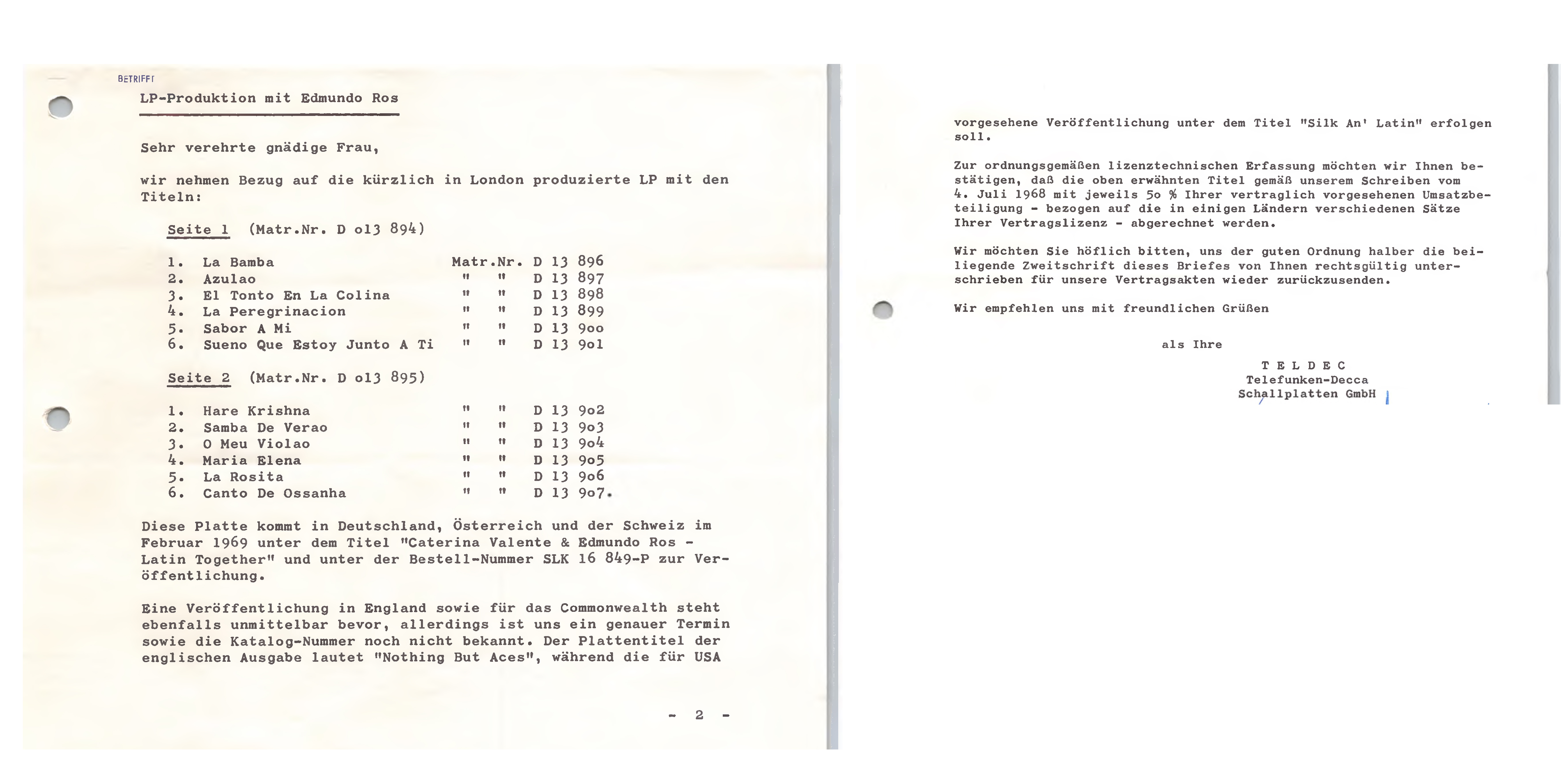
If you were a fan of Latin-infused pop in the late 60s, you might remember a moment of magic. In 1969, two giants of the international music scene, the versatile Caterina Valente and the “King of Latin American Music” Edmundo Ros, reunited in a London studio. The result was a sparkling, brass-filled album of Latin standards and pop covers that captured a unique cosmopolitan energy.
But here’s where the story gets complicated, and where our investigation begins.
This single album was released not under one name, but three, tailored for different markets:
‘Silk‘n’Latin’ for the USA on the London Label
‘Nothing but Aces’ for the UK and Commonwealth on the Decca UK Label
‘Latin Together’ for Germany on the Decca Germany Label
All were released under the banner of Teldec, a now-vanished label that itself is a relic of industry entanglements. Teldec was a 1950s joint venture between Germany’s Telefunken and the UK’s Decca Records (its name a portmanteau of both). This is a crucial piece of the puzzle.
To understand the ownership chain, you have to follow the corporate spaghetti:
Decca Records split into separate British and American entities decades ago, leading to the creation of London Records to handle UK Decca releases in the US.
Teldec’s parent companies eventually pulled out, and the label was sold off, first to WEA (Time Warner)
Meanwhile, the original Decca UK Records was sold to PolyGram, which was also acquired by Universal Music Group.
In short, the rights to this album, through decades of corporate acquisitions and mergers, have almost certainly been consolidated under two of today’s music super-giants.
But here is the heart of the matter, and the reason this 50-year-old album matters today: Corporate ownership of a master recording does not erase the original contract with the artist.
And that’s where the system has broken down, spectacularly.
Our investigation has uncovered that despite this tangled corporate history, one thing remained crystal clear: the original contract signed by Valente and Ros. This legally binding document granted them fundamental, inalienable rights—most notably, the right to approve specific uses of their recordings (like synchronization licenses for film and TV) and the right to receive royalties when those recordings are used.
Yet, a major label—positioning itself as the album’s ‘sole owner’—licensed a track from this very album for a significant Hollywood production. We have confirmed this track was used in the 2020 film ‘Misbehaviour’ (a film about the disruption of the 1970 Miss World pageant, ironically centered on a fight for respect and rights).
Shockingly, this was done without seeking the consent of Caterina Valente or the estate of Edmundo Ros.
This isn’t just a simple administrative oversight. It is a fundamental breach of the contractual obligations the label inherited when it acquired the catalog. The label’s claim of ‘sole ownership’ conveniently ignores the artists’ enduring rights embedded within that very ownership. You can’t claim to own the asset while disregarding the covenants that are attached to it. After legal intervention said Film Sync Rights were settled.
Even more infuriating? This is not a new problem.
For over twenty years, the artists’ representatives have consistently notified the major labels involved about these breaches. They have flagged that this album has been distributed digitally without proper licensing, a form of corporate piracy that these very labels should aggressively pursue. Yet, they have permitted it to continue, showing a complete disregard for resolving the situation.
The existing contract places an unequivocal, fiduciary responsibility on the labels to manage the artists’ catalogue in good faith. This means they have a legal duty to act in the best financial interest of the artists—a duty they are blatantly ignoring.
The case of Silk’n’Latin / Nothing but Aces / Latin Together is a microcosm of a much larger disease within the music industry. It shows how artists’ legacies can be lost in a labyrinth of mergers and acquisitions, how contracts are ignored, and how fiduciary duty is abandoned for convenience and profit.
It proves that even for world-famous artists with a clear paper trail, the system is often stacked against them. If this can happen to Caterina Valente and Edmundo Ros, what chance does a lesser-known artist have?
The labels involved have been silent for two decades. It’s long past time they answered for it.