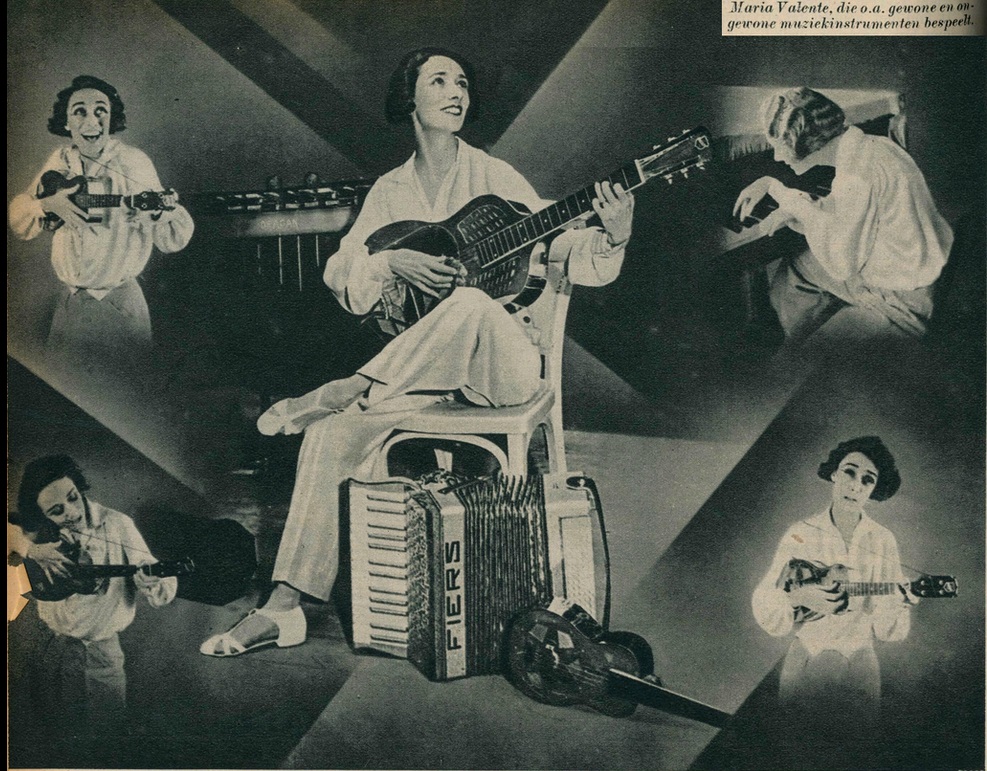
For over thirty years, she has compelled millions across all continents to laugh. A woman no longer young, yet possessing the slender agility of a seventeen-year-old. A woman who was a mother eleven times, yet still capers about like a young boy. A woman who plays thirty-three instruments, who dances and sings—and in her spare time, mends her sons’ trousers and children’s socks. This is Maria Valente, a name familiar to every visitor of Germany’s grandest variety theaters. A Roman by birth, with genuine Italian temperament, she whirls across the stage in a fireworks display of ideas, tumbling over herself in witty musical puns.
“The only female clown in the world!”—so the posters often announce her. But a clown? Maria Valente does not glue on a red nose, paint a comical mask on her face, nor shroud herself in grotesque costumes. She arrives with a tambourine or a concertina, a merry laugh on her face, dressed in wide trousers and a white silk shirt. Entirely without gimmickry, she captivates through her sheer presence and artistry. With the serious concentration and energetic dedication of a child, she hammers out a xylophone accompaniment to the orchestra’s melody; with playful roguishness, she lets small metal plates melodically chime upon a tabletop during an English waltz.
She is a master of the guitar and the accordion, the piano keys and the violin strings, the banjo and the flute—an artist whose comprehensive talent has thrilled audiences in every country on earth. Alongside the cheerful rhythms of English and the melodic sounds of Italian music, she holds a deep love for the German masters. During her last performance in Mexico, she played Brahms so masterfully on the concertina that the listeners demanded encore after encore, showering her with such stormy ovations that she had to escape through a back door of the theater.
So who is Maria Valente? Born Maria de Siri in Rome during one of her father’s tours, she was the daughter of a renowned Roman musician, a conductor and inventor of novel instruments who traveled the world. Five generations of artists—dancers, musicians, acrobats, and singers—bequeathed their talents to young Maria, whose abilities were startlingly diverse even as a child. She spent her early years in Russia, a gifted girl who knew only one great passion: Music! Music!
The turmoil of the Bolshevik Revolution tore the family apart. Maria fled to Finland, where she eked out a meager living as a piano player and actress in small, provincial theaters. It was there she met the quiet young artist, Giuseppe Valente. After a short courtship, they married, and he became her partner for life and profession. During the chaos of the great Finnish uprising, Maria had her first child. She had no money, no opportunity to work, and scarcely knew how to find food for her husband and baby. When their need was greatest, she cut off her long, beautiful hair and sold it to a wigmaker to at least buy bread and milk. Yet through all these difficulties, she never lost the courage and tenacity that had characterized her parents and ancestors before her. She worked tirelessly, learning to master new instruments, and told herself: “One day, I will make it!”
She returned to Italy with her husband and their two eldest children. After a hard struggle, her career gradually began to ascend. First smaller, then larger variety stages took notice of the unique talent of “Maria Valente.” She continuously developed her act with clowneries and funny ideas, managing to hold the audience’s interest without a pause for forty minutes. However, artistic fame did not mean a carefree life for the “most musical woman in the world.” Of the eleven children to whom she gave life, she had to bury seven. She never parted from the remaining four. They learned to play and dance from her, and from sixteen-year-old Giovanna down to eight-year-old Kathrin, each one is thrilled to train with their famous and beloved mother.
Thus, from play, work, and seriousness, a cheerful little “Scottish family parade” was born, featuring all the Valentes—an act that now marches across variety stages to great applause. As in his wife’s temperamental scenes, father Valente also participates here, playing the accordion with an immovably serious expression.
For thirteen years, Maria Valente has been a permanent guest on German variety stages. She has become a familiar, returning performer to all visitors of Berlin’s “Wintergarten.” Whether she appears as a Mexican cowboy, tap dances, plays the concertina, strums a small silver banjo as accompaniment to a funny little song, or whirls through a Spanish tarantella at a breakneck tempo, she always sweeps her listeners away into storms of applause.
Yet between the matinee and evening performances lie the hours in which Maria Valente transforms from the artist into the mother, who oversees her children’s homework, shares their small worries, and rejoices with them. In Argentina, England, Sweden, and Germany, the artist has her public. In every country, her act is different, tailored to the mentality of the audience—but the few free hours between work belong everywhere, and exclusively, to her children and her private life. Here lie the roots of the vital, joyful, and comprehensive artistry of the temperamental artist, Maria Valente