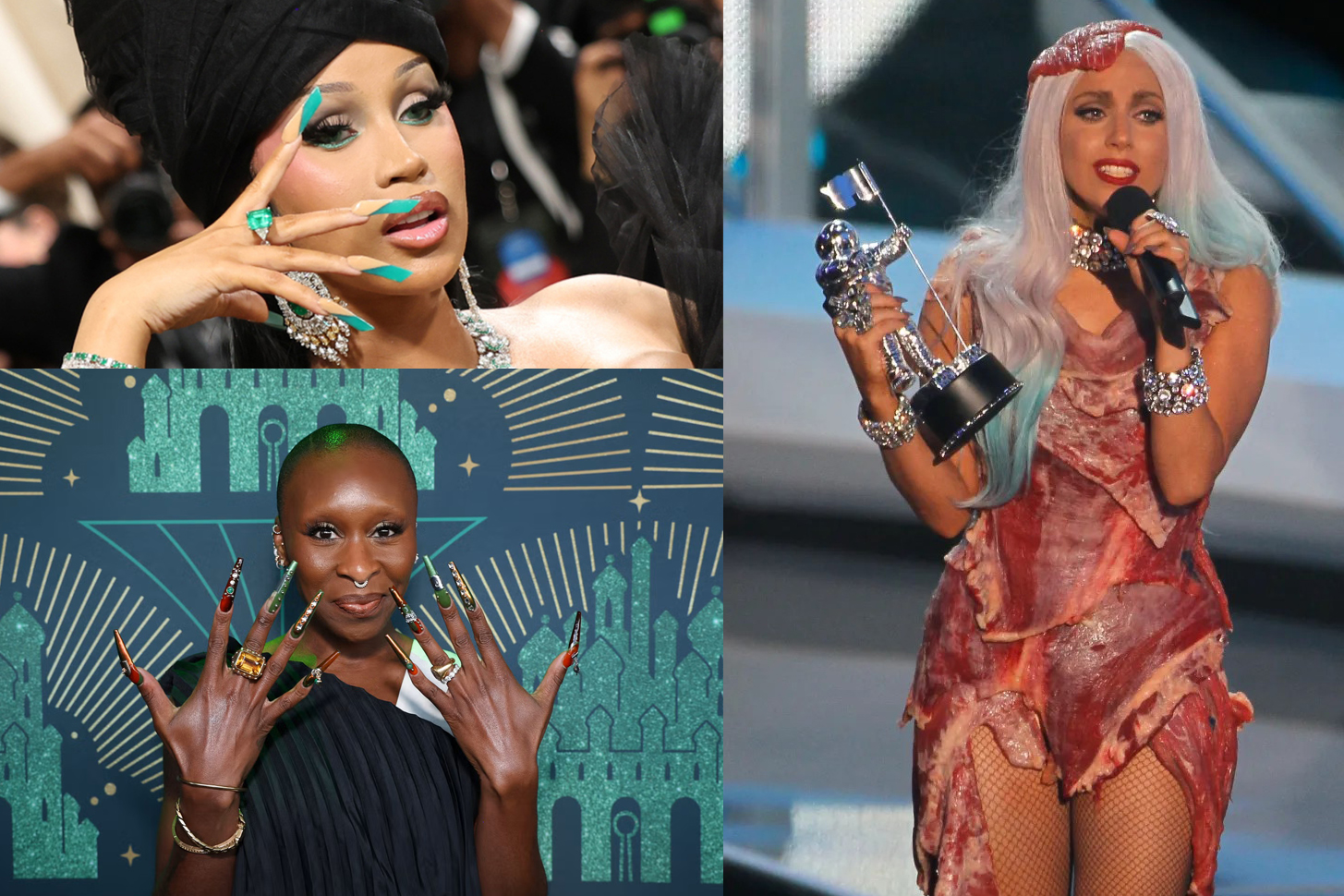
We are living in an age of amplification. From our digital feeds to our city streets, a new aesthetic of excess has taken hold, one that demands to be seen, heard, and—most importantly—not forgotten. But what is the driving force behind this pervasive trend? And at what point does personal expression cross an unspoken line into the realm of the absurd?
This is an investigation into the cult of “Over-the-Top.”
**The Evidence: A Landscape of Exaggeration**
The clues are everywhere, if one knows where to look. Observe the female-presenting individual on the morning commute: her face is a masterpiece of technical application—contoured, highlighted, and framed by eyelashes so dense and sprawling they create their own microclimate. Her hands, when they grip the subway pole, reveal talons—elegantly sculpted, yes, but of a length and intricacy that render simple tasks like retrieving a keycard a minor athletic feat.
But to assume this is a singularly feminine phenomenon is to miss half the story. Look closer at the male-presenting cohort. Their canvas is not the face, but the skin itself. The “tattoo epidemic,” as it’s been termed, has evolved from discrete symbols of meaning to full-sleeve narratives, neck-to-scalp murals, and bodysuits of ink that leave little epidermis untouched. It’s a permanent declaration of identity, worn for all to see.
The crime scene, it seems, is the entire public sphere.
**The Question of Motive: Narcissism or Something Else?**
The immediate suspicion, and one that many armchair psychologists are quick to level, is a collective surge in narcissism. In a world saturated with stimuli, is being “Over-the-Top” simply a survival mechanism? A desperate bid to stand out in an endless scroll of human content? The “inn” trait, as our source suggests, may indeed be a performative self-obsession, where if you are not loudly proclaiming your individuality, you are functionally invisible.
This theory finds its most compelling evidence in our celebrity and influencer culture. Here, the normal rules of aesthetics are not just bent; they are shattered. We see it in the surgically-altered faces that defy human anatomy, the fashions that prioritize shock over wearability, and the public spectacles that blur the line between person and persona. The message is clear: subtlety does not trend.
**The Corollary: The Banishment of “Class”?**
This investigation must then confront a more subjective, yet crucial, question: In this race for creative self-expression, have we abandoned “class”?
The term is antiquated and loaded, often synonymous with elitism. Yet, it traditionally implied a quiet confidence, an elegance that needed no explanation. The new regime, however, appears to champion its opposite. Consider the case of the golden interior design favored by a certain president—a gilded monument to opulence that many would describe as the very definition of “bad taste.” But herein lies the twist: in today’s economy of attention, is “bad taste” simply more effective? Is being memorable, even for being garish, now a higher value than being tasteful?
**The Cultural Accomplices: Art, Fashion, and the Market**
No investigation is complete without identifying the accomplices. The so-called “art market” and “fashion market” are not mere reflections of this trend; they are its active accelerants. They have a vested interest in the new, the extreme, and the conversation-starting. A quietly beautiful painting is less likely to break the internet than a shark suspended in formaldehyde. A simple, well-tailored garment generates fewer headlines than an outfit constructed from raw meat or technological absurdity.
These markets validate the “Over-the-Top,” monetizing our shock and confusion, and in doing so, signal that this is the direction of culture.
**The Final Analysis: Decadence or Democracy?**
So, what is the final verdict? Have we, as alleged, reached a “new height in the history of decadence”?
There is a strong case to be made. The focus on the superficial, the extreme, and the personally gratifying over the communal or subtle could be interpreted as a societal drift towards decadent self-indulgence.
However, an alternative theory persists. Perhaps this “Great Exaggeration” is not a decline, but a democratization. For centuries, standards of beauty and presentation were dictated by a powerful few. Now, with social media as a global stage, the power to define what is aesthetically acceptable has been distributed to the masses. The heavy makeup, the prolific tattoos, the outrageous nails—these are not acts of conformity to an old standard, but declarations of sovereignty over one’s own body and image.
The line between self-expression and ridiculousness, it turns out, is not a fixed boundary but a shifting cultural consensus. We are all witnesses—and participants—in a vast, uncontrolled social experiment to see where that line will be drawn next. The investigation remains open.