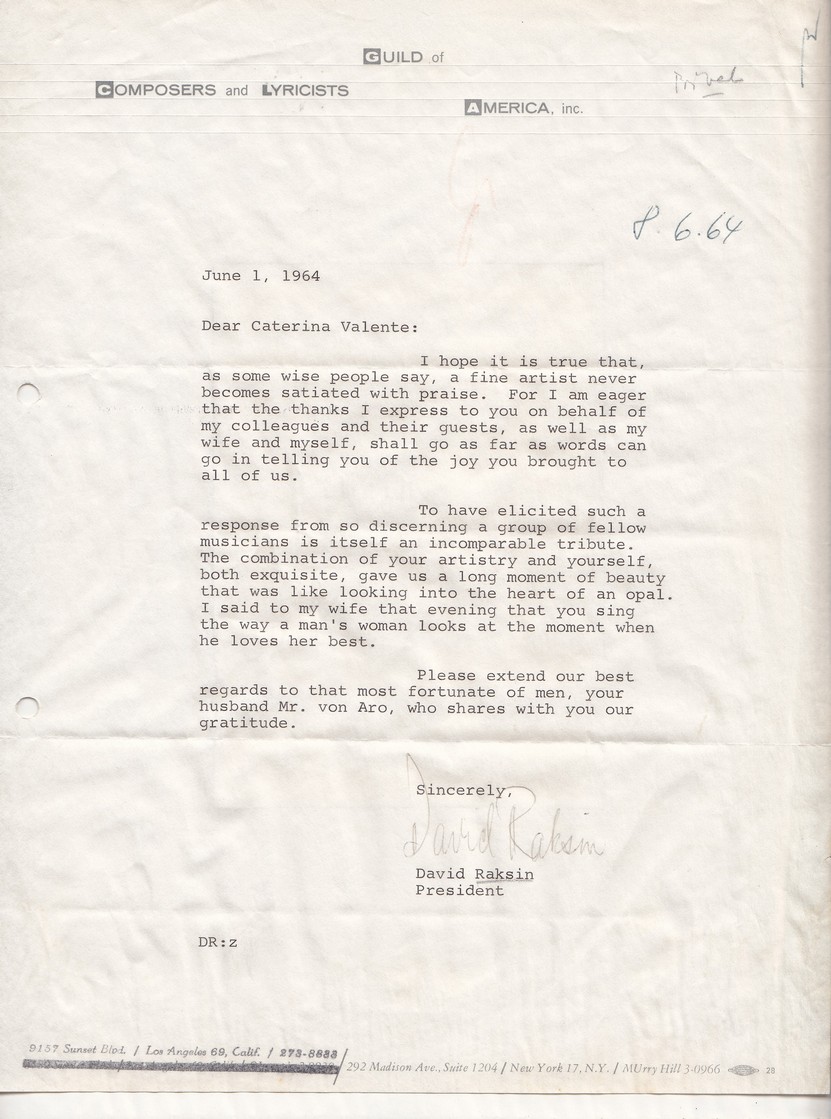
In the grand tapestry of post-war European pop culture, few threads are as vibrant and enduring as Caterina Valente. A singer, dancer, and guitarist of phenomenal talent, she became a symbol of a Germany joyfully rediscovering its zest for life during the Wirtschaftswunder—the economic miracle of the 1950s.
Her career is a matter of public record: a string of international hits, sold-out world tours, and a successful stint on American television that would be the envy of any artist today. Yet, the story of how we remember our icons is not always written by the audiences who adored them. Sometimes, it’s shaped by the fascinating, and occasionally bizarre, interpretations of those who document them from the sidelines.
It’s quite interesting, or better yet funny, to see what people write when they have nothing better to do. Especially in this day and age where any publication can be amplified, it’s worth examining the curious space between a star’s actual legacy and the projections placed upon them.
Case Study #1: The Overzealous Fan with a Press Pass
The first case involves a respected journalist from one of Germany’s most important papers. An architectural historian by specialty, he approached Valente with a proposal: he wanted to write a book about her career. Flattered by the interest from such a prestigious source, she consented to a series of interviews at her home.
The sessions began with a moment of pure, unscripted comedy. The journalist’s bag, a treasure trove of scholarly intent, was raided by Valente’s dachshund, who emerged triumphantly with a very personal item—a condom—and paraded it through the apartment. Valente laughed; the journalist was mortified. It was a human moment, a break in the formal facade.
Unfortunately, that was the last genuine laugh she would have regarding this project. When the book was published, it was so far-fetched and bizarre in its interpretations that it bore little resemblance to the reality of her life and career. The narrative had become a projection, a fantasy of what the journalist wished his idol to be, rather than who she was.
The coda to this story is a study in contrasts. The same journalist was later assigned a story on Valente for the paper’s magazine. This time, the narrative was visual. With the master photographer Mauro Balletti and Valente’s son as stylist, they created over a dozen stunning scenarios. The resulting article was a triumph, brilliantly capturing the many facets of her ubertalented persona.
The final, cringeworthy note? As a “thank you,” the journalist presented Valente and the photographer with a CD of himself, in a live concert, singing her songs. The listening session, by all accounts, was dreadful. The analysis is clear: sometimes, admiration can blur the line between documenting a subject and wanting to become them.
Case Study #2: The Armchair Academic and the YouTube Audition
The second case takes us across the Atlantic to a German university professor in the US. He penned an analysis of Valente’s global career, based largely on YouTube clips and a film by Werner Schroeter that featured some of her music.
His thesis? That Valente’s numerous appearances on American television in the 1960s were essentially a series of “auditions,” where she constantly had to prove her capabilities as a triple-threat performer.
What his analysis completely ignored was a rather significant piece of evidence: Caterina Valente didn’t just audition; she was hired. She co-hosted 22 episodes of a CBS prime-time variety show called The Entertainers, for which she was officially awarded a prize as “Best Singer on American Television.” One might surmise that consistently landing a prime-time network television gig is the very definition of having passed the audition—not just with network executives, but with the American public itself.
So, What is the Valence of Valente?
These two stories leave us with a compelling question: what is the true cultural valence of Caterina Valente?
Is it the Germany of the Wirtschaftswunder, seeing in her boundless energy and cosmopolitan charm a reflection of its own optimistic rebirth? Is it America, who welcomed her not as a perpetual contestant, but as a polished, award-winning star worthy of sharing the screen with the likes of Bob Newhart, Carol Burnett, Dean Martin, Danny Kaye, Bing Crosby and many more?
The moronic opinions of two individuals? Hardly. While their platforms gave them an outsized voice, their interpretations say more about their own perspectives than about Valente herself. One saw a fantasy; the other saw an audition tape. Both missed the main event.
The true valence of Valente is not found in these academic or journalistic misfires. It is found where it has always been: in the enduring delight of audiences who still stream her music, watch her performances, and enjoy the timeless talent of an artist who didn’t need anyone’s projection to shine. The stage was always hers to command.